Why Keeping Quiet is a must-read for all-sports fans
Posted: July 7, 2012 Filed under: Cricket, Leicester | Tags: Book reviews Comments Off on Why Keeping Quiet is a must-read for all-sports fans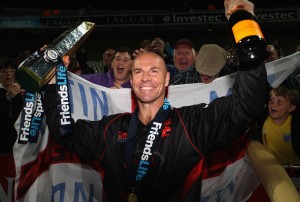
Paul Nixon (above), who enjoyed a distinguished career as a wicketkeeper and batsman (and occasional bowler) for Cumberland, Leicestershire, Kent, Delhi Giants and England, was no ordinary cricketer.
And his autobiography, Keeping Quiet, produced in association with Jon Colman, is no ordinary book.
As anyone with the fortune and privilege to witness “Nico” in action will confirm, there is a certain irony in the title.
Whenever he took to the field, before his playing career ended in 2011, he could never be described as a shy and retiring type. Indeed, he was one of the most vociferous English players of the modern era, perhaps of any era.
For one of the all-time cricket legends to pen a foreword to the book would be regarded as a great honour. The fact that TWO – Steve Waugh and Sir Vivian Richards – have chosen to do so is an indication of the respect with which Nixon is held throughout the world game.
Both of those giants recognised, from an early stage in their careers, the importance of mental fortitude at the highest levels and used this knowledge as a springboard for their achievements.
As Nixon acknowledges, he took somewhat longer to come to terms with such demands, but once doing so, he was successful in prolonging his career well beyond the standard retirement age.
The pride with which he recounts the 2006-07 tour of Australia, where he made his international debut (at the age of 35!) and helped to inspire England to a remarkable one-day tournament victory, shines vividly throughout every word of that particular account.
As a cricketer, Nixon was renowned for his passion, commitment and honesty. It is a delight to report that this book bears the same positive traits.
Throughout his career, he played hard and by his own admission, partied even harder.
This led to many adventures, many of which may have seemed amusing at the time (and perhaps even more so in hindsight), but also others which were downright scary.
He reaches the conclusion that a guardian angel is watching over him. The evidence presented to back this idea certainly gives pause for thought.
The author featured heavily in Leicestershire’s County Championship triumphs of 1996 and 1998, together with the three T20 titles in 2004, 2006 and 2011, and gives his role in those successes the attention it richly deserves.
Lesser authors may have focused on them exclusively. But Nixon also covers the darker sides of his two spells at Grace Road – from the divided dressing-room which blighted his early years in county cricket through to the bitter political in-fighting which prompted a recent player exodus and has weakened the county’s performance at four-day level for several seasons.
In addition, he tackles, in typically-direct style, some of the global challenges currently faced by the game. As a close friend of the late Hansie Cronje, and a leading player in the equally ill-fated Indian Cricket League, Nixon was already well-acquainted with the damage inflicted by match-fixing scandals. So it is little surprise that an attempt by an “acquaintance” offering a £5million bribe, to persuade him to rig a 2010 T20 game at Durham proved to be unsuccessful.
Many faced with such a massive temptation may well have succumbed. It is a tribute to Nixon’s character, evident in his report of this episode, that the question of him doing so never even arises.
Another disquieting note occurs when a snide tabloid comment by an ex-England colleague, concerning Nixon’s role in an alleged incident during the 2011 T20 final, was picked up by the England and Wales Cricket Board and led to an official letter of censure being sent to both player and county.
Nixon, who denies the incident even occurred, is rightly aggrieved at never being given the chance to present, let alone defend, his case at any official hearing. However the tale illustrates to a disturbing degree the craven subservience of the national cricketing powers-that-be to the demands of the media, and in particular, one (lately somewhat-discredited) area of it.
As throughout much of its history, Leicestershire are enduring some difficult times at present. But many fans will hope that Nixon’s service will continue for many years – not only as a coach and mentor to the present squad. In the long-term, Nixon is ideally suited for a community/club ambassador role, similar to that which Alan Birchenall has performed with such distinction for those Foxes on the other side of Aylestone Road.
He has been, over many years a credit to both his native Cumbria and his adopted city and county. Long may he continue to be so!
Keeping Quiet, published by The History Press, is now available at all quality bookshops and also via http://www.amazon.co.uk. An e-book version for Amazon Kindle is available at http://ow.ly/c4ZqC
Colin Hall’s first e-book, We Were The Quarry, will be published by LeicesterVoice in August 2012.
The fight for Glenfield must go on
Posted: July 5, 2012 Filed under: Health, Leicester | Tags: Glenfield Hospital Comments Off on The fight for Glenfield must go on
The plans to close the children’s heart unit at Glenfield Hospital are a sickening blow for staff, campaigners and the East Midlands alike.
Many parents openly wept when health bosses broke the news towards the end of a five-hour meeting, streamed online, in London.
Hundreds of children across the region, and parts of East Anglia, will now be expected to travel to Birmingham if the plans to close the unit are accepted by the government.
But grave doubts persist on whether the facilities there can be expanded quickly enough to cope with the increased volume of patients.
It is also particularly distressing to learn that the Bristol Children’s Unit, whose continuous and sustained failings during the 1990s prompted the original national clinical review, is being recommended for retention.
The closure, if implemented will have a severe impact on existing heart care for adults at Glenfield. The internationally-renowned Extra-Corporeal Membrane Oxygenation (ECMO) service, based at the hospital and credited with saving the lives of hundreds of children and adults, would be placed at immediate risk. In turn, such uncertainty will clearly undermine existing high standards of care, as highly-qualified staff with years, even decades, of service seek to move elsewhere.
Meanwhile other regions, who have also lost out under the review, have signalled their determination to continue with their struggle.
All five political groups at Leeds City Council have already indicated their intention to submit an appeal to Health Secretary Andrew Lansley against the plans to close the Children’s Heart Unit at Leeds General Infirmary.
Their immediate response, which has engaged, mobilised and united all sections of the community, has set an example which other authorities in Leicester, Leicestershire and the rest of the East Midlands would do well to follow.
There are legitimate questions to ask about the role of the University Hospitals of Leicester Trust, and whether recent uncertainties about its management and financial planning may have been a factor that counted against Glenfield.
However, now is not the time for detailed public recriminations. Instead, local councils and the Trust must hold urgent talks to consider a co-ordinated response and contemplate their next move in a saga which may yet still have some way left to run.
At present there are many questions, raised during the extensive public consultation process that took place during the review, which remain unanswered. Unless and until they are resolved to the satisfaction of concerned families – whose interests should remain the driving force behind any changes – the question of closing ANY children’s regional heart unit should not arise.
Furthermore, as the recent furores over the budget have shown, the government can be forced to change its mind if the political tide dictates this. With dozens of Tory MPs already indicating a willingness to defend the interests of their communities on this issue, there must be a significant doubt whether the recommendations can survive unscathed. This gives rise to the possibility that at least one of the units now under threat could be reprieved.
The campaign to save Glenfield must therefore continue, for the sake of current and future heart patients.
 Leicester Voice